Thursday, January 2, 2020

This Air Jordan 1 Low SE Homage Black White W Releases On November 3rd Sneaker News

Yet another colorway of the spikeless golf shoe emerges. The Nike Air Foamposite One “Penny PE” in White/Black is releasing in early 2023 at select retailers and on Nike for $240 USD. Jordan Brand released an exclusive Air Jordan 1 that was limited to...

Air Jordan 1 Low Split Black White Back in 2018, Jordan Brand experimented with the color blocking on the Air Jordan 1 with the introduction of the “Homage To Home” colorway. Taking the "Chicago" and "Bred" colorways and splitting them halfway on each sneaker. Since then we haven’t seen another release to the public with this colorblocking, that is until the Air Jordan 1 Low “Split” Black White drops. Cleared payment cleared payment - opens in a new window or tab.

Take an Official Look at Air Jordan 1 "Homage to Home"

The Air Jordan 1 ‘Homage to Home’ is a Sample that was just unveiled by Jordan Brand. The model combines two classic colorways, the Air Jordan 1 Banned and the Air Jordan 1 Chicago. Sole Retriever finds sneaker raffles and sneaker releases from around the globe, giving you the best chances to cop the latest sneaker releases for retail. “Block ads on – This website” switch off the toggle to turn it from blue to gray.

Down below things remain more standard with a white midsole and black outsole combo completing the look. The Air Jordan 1 Low Split Black White W is set to release on November 3rd, 2022 through Nike and select Jordan Brand retailers online and in-store. Coming in women's sizing, the retail price is set at $120. In the second half of 2017, we were hit with a rumor of a split Jordan 1 OG High including the lateral side of a “Bred” and medial side of a “Chicago” Jordan 1.

A “Homage to Home,” but in the form of the AJ 1 Mid.

Check out our Jordan release calendar, and keep it locked to our Twitter and the Sole Retriever mobile app. If you're looking for a more in-depth breakdown of the Air Jordan 1 and upcoming releases, check out our Air Jordan 1 Buyers Guide and our Air Jordan 1 Release Dates Page. Split right down the center of the silhouette from toe to heel is a black and white color combo, inverting the colors on each half of the sneaker. Tumbled leather dresses the upper with, again, a split color design featuring a white base on the lateral side and a black base on the medial. Branding comes split in half on the tongue with the heel overlay’s Jordan Wings logo embroidered in all-white. Black flat laces contrast and aid the split tongue design.

Jordan Brand splits the AJ1 Low in half with two different color placements. It will turn gray and the text above will go from “ON” to “OFF”. Switch off the toggle to turn it from “Enabled on this site” to “Disabled on this site”. In the browser extension area in the upper right-hand corner. Designed to tie in with the release of the PlayStation exclusive.

The AMBUSH x Nike Air Adjust Force Is Set To Drop In Orange

Interest will be charged to your account from the purchase date if the balance is not paid in full within 6 months. Select PayPal Credit at checkout to have the option to pay over time. This item is verified by professionally trained authenticators before delivery. Two of Jordan Brand's "split" color blocking of the Air Jordan 1...

air jordan 1 homage to home release info

The blue detailing is seen on the insoles and the three-line patter on the heel tab and tongue tab, while the rest of the shoe sits atop a translucent outsole to round out the design. The black and white colorblocking on this upcoming pair features both tumbled and smooth leather panels. The stitched seam visibly splits the shoe in two, as it runs through the middle of the toe box, and up through the tongue. The colors are also inverted on the tongue tag and the Jumpman logo.

This Air Jordan 1 Retro High OG was originally an unreleased exclusive, made to pay tribute to the “Windy City.” Known as the “Homage to Home” edition, they released one year later, in 2018. Coming in black, university red and white, this pair combines two classic AJ 1 colorways, the “Chicago” and “Banned” editions. Splitting the sneakers in half, the “Banned” portion is on the medial side while the “Chicago” is on the lateral.

air jordan 1 homage to home release info

DTLR recently took to Instagram to preview a photo that points to a drop going down very soon at both DTLR and Villa – two retailers with multiple locations in the Chicago area. Earlier this month, we reported two upcoming release dates with different style codes – April 21st and May 19th – devoid of information regarding the differences between the two drops. It is likely that the first pair will be a Chicago-exclusive based on the inspiration behind this colorway and the advertisement you see below. Stay tuned for any and all updates as they become available and check out our Jordan Release Dates page in the meantime.

See the seller’s listing for full details and description of any imperfections. Please allow additional time if international delivery is subject to customs processing. This listing was ended by the seller because the item is no longer available. The Shanghai-based brand is delivering tonal navy and white colorways. Is slate to bring back the Air Foamposite One for 2023, releasing one of the rarest colorways of Penny Hardaway’s PEs.

Collecting since he was in elementary school, his collection has grown to over 500 pairs and counting. Brian has published articles since 2004, and in 2006, he decided to create Sneaker Files. Get real-time notifications for every sneaker raffle, stay in-the-know with all of the latest releases and news, quickly enter raffles, and much more. When it turns gray, click the refresh icon that has appeared next to it or click the button below to continue. Jordan Brand will be releasing the Air Jordan 1 Homage to Home this Spring 2018 that combines two iconic colorways, the Air Jordan 1 Banned and Air Jordan 1 Chicago.


Wednesday, January 1, 2020

Home Equity Loan Interest Still Tax Deductible

Homeowners who bought before then can still deduct the interest on mortgage debt of up to $1 million. The IRS this week clarified a provision of the Tax Cuts and Job Acts that eliminates the deduction for interest paid on home equity loans and lines of credit. You do not need to report loan proceeds as income, and you cannot deduct interest payments on those loans. However, the IRS makes an exception for personal loans that are secured by a residence, as is the case with mortgages, home equity loans, and HELOCs. You can deduct the interest on up to $750,000 in home loan debts if the loans were made after Dec. 15, 2017. If your total mortgage debt is higher than that, then you wont be able to deduct all of the combined interest paid.

Also included in this bunch are expenses related to investment fees, legal fees, home office use and alimony for divorces finalized after December 31, 2018. These deductions will be reinstated in 2026 unless Congress votes to extend the current rule. That means it will be a lot tougher to qualify to itemize deductions. If your mortgage existed on Dec. 14, 2017, you’re grandfathered in on the $1 million maximum.

How We Make Money

Highest rate is applicable to taxable income above $500,000 for single taxpayers and head of household, and $600,000 for married taxpayers filing jointly. So, many taxpayers tapped into their home equity to pay for, say, vacations, college tuition, vehicle purchases and living expenses. And they counted on deducting interest on those loans each tax year. The new rules for deducting interest on home equity loans will put a wrench in those plans, starting in 2018. The good news is not all these changes will apply this upcoming year. On December 2017, President Donald Trump signed the new tax reform law called Tax Cuts and Jobs Act.

Note the limitation is per taxpayer which increases the limitation for single co-owners / registered domestic partners. Generally, you have a reasonable basis if your chances of withstanding an IRS challenge are greater than 50%. Reliance on a competent tax advisor greatly improves your odds of obtaining penalty relief. Other possible grounds for relief include computational errors and reliance on an inaccurate W-2, 1099 or other information statement. Tax-filing inaccuracy.These penalties may be imposed, for example, if the IRS finds that your return was prepared negligently or that there’s a substantial understatement of tax.

Is There A Best Time Of Day For Therapy? Here's What Therapists Say.

It is applicable only when the mortgage is not higher than the refinanced debt. Homeowners cannot deduct the interest paid on a home equity loan or home equity line of credit if they used the debt to increase the value of the home. Say that in January 2018, a taxpayer took out a $500,000 mortgage to buy a home valued at $800,000. Then, the next month, the taxpayer took out a $250,000 home equity loan to build an addition on the home. Before, taxpayers could include state and local property taxes as itemized deductions.

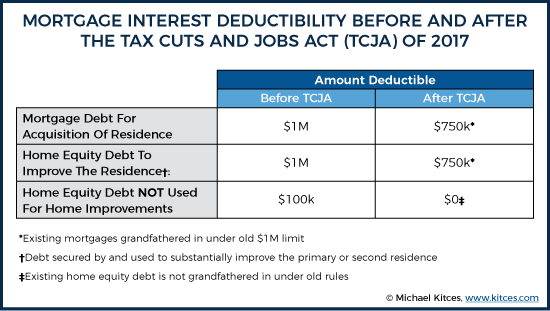
The I.R.S. also noted that the new law sets a lower dollar limit on mortgages over all that qualify for the interest deduction. Beginning this year, taxpayers may deduct interest on just $750,000 in home loans. The limit applies to the combined total of loans used to buy, build or improve the taxpayer’s main home and second home. You can deduct the interest on up to $750,000 in home loan debts, if the loans were made after Dec. 15, 2017. If your total mortgage debt is higher than that, you won’t be able to deduct all of the combined interest paid. The $1 million cap applies for mortgages obtained before that date.

IRS Clarifies Home Equity Loan Tax Deductions Under New Law

For alternative minimum tax purposes, however, you could deduct the interest on these amounts only if the home equity loan proceeds were used to buy or improve your first or second residence. There are limits on the amount of home equity loan and lines of credit interest that can be deducted because the new tax law caps the total amount of home-related interest that can be written off. Interest on mortgage debt up to $750,000 can be deducted on homes purchased after Dec. 15, 2017.

2018 tax law home equity loan deduction

However, if you use the proceeds of the loan for what the IRS deems to be "substantial improvements" to your home, and meet other criteria, home equity loan interest may still be deductible to an extent. Under the new law the interest paid on home equity loans will no longer be tax-deductible. However interest on a HELOC loan that is obtained to acquire, build or substantially improve the residence will remain deductible. Though the miscellaneous deductions outlined above have been suspended through 2025 for regular employees, self-employed workers can still write-off qualifying work-related expenses. Deductions such as self-employment taxes, insurance premiums and yes ― a home office ― can be claimed using the Schedule C form.

Interest on Home Equity Loans Is Still Deductible, but With a Big Caveat

You should receive IRS Form 1098 from your lender with details about the interest you've paid on your home equity loan. Of Schedule A (Form 1040.) Any non-tax deductible interest paid on a home equity loan needs to be reported on line 8b. Speaking with a tax preparer who is familiar with the details of your home equity loan can help you avoid any problems when taking the deduction. The private mortgage insurance deductionwas re-upped for tax year 2017. Ditto the residential energy tax credits for installing things like energy-efficient windows and doors, water heaters, furnaces, and insulation. The student loan deduction— up to $2,500 if you’re repaying — stays put, and you don’t have to itemize to take it.

2018 tax law home equity loan deduction

According to the IRS, interest on home equity loans or home equity lines of credit is not tax deductible if the borrowed amount is not used to buy, build, or substantially improve the home against which the money was borrowed. To get more than your standard deduction, you might need a sizable loan or other expenses to help . If you are on the fence about a property remodel, then borrowing against your home just to take advantage of deducting the interest is probably not your best choice. Taking out a home equity line of credit may still be worth it even if the interest is not deductible to you, depending on how you plan to use the money. If youre interested in consolidating credit card debt, for example, and if you can get a much lower rate with a HELOC, then you could save money this way. Of course, this strategy assumes that youll pay the HELOC down as quickly as possible to minimize interest charges and that you wont run up new debt on the cards that youve paid off.

Mortgage interest deductions

You'll start receiving the latest news, benefits, events, and programs related to AARP's mission to empower people to choose how they live as they age. We know you have many options when it comes to accounting firms in St. Paul or the Twin Cities area, and we know we’re not the right fit for everyone—but when you’re ready to start a conversation, we’ll be ready to listen. The Balance uses only high-quality sources, including peer-reviewed studies, to support the facts within our articles. Read our editorial process to learn more about how we fact-check and keep our content accurate, reliable, and trustworthy. Ebony Howard is a certified public accountant and a QuickBooks ProAdvisor tax expert. She has been in the accounting, audit, and tax profession for more than 13 years, working with individuals and a variety of companies in the health care, banking, and accounting industries.

2018 tax law home equity loan deduction

The interest on home equity loans cannot be deducted for tax purposes if the proceeds were not used to buy, build or substantially improve your home. You can deduct interest on a home equity line of credit , but only if you use the funds for home improvements. The introduction of the Tax Cuts and Jobs Act eliminated deductions on interest if you use the funds for anything else, such as to consolidate debt.

It might even provide some tax benefits since the interest you pay is sometimes deductible. But if you use the money to pay off credit card debt or student loans — or take a vacation — the interest is no longer deductible. But the Internal Revenue Service, saying it was responding to “many questions received from taxpayers and tax professionals,” recently issued an advisory. According to the advisory, the new tax law suspends the deduction for home equity interest from 2018 to 2026 — unless the loan is used to “buy, build or substantially improve” the home that secures the loan. Under prior tax law, a taxpayer could deduct “qualified residence interest” on a loan of up to $1 million secured by a qualified residence, plus interest on a home equity loan up to $100,000.

2018 tax law home equity loan deduction

2018 Tax Law changes that affect Homeowners

Also, you can refinance that existing mortgage and keep deducting the interest on up to $1 million of debt, so long as you don’t increase the amount you owe with the refi. The sweeping tax bill signed into law just before the 2017 holidays brings changes for virtually all homeowners -- but, for the most part, not until you file your 2018 tax return in 2019. All of this is subject to the new $750,000 debt limit on the total amount of all loans.

Rebecca Lake is a journalist with 10+ years of experience reporting on personal finance. This copyrighted material may not be republished without express permission. The information presented here is for general educational purposes only.

Some Home Equity Loans Still Deductible

The Tax Cuts and Jobs Act of 2017 introduced a slew of new tax breaks while doing away with several others. Some of the tax changes directly affected taxpayers who own a home or plan to purchase one. Under the old rule, taxpayers could claim a child tax credit of $1,000 per child under the age of 17. It then decreased by $50 for every $1,000 a taxpayer earns over specific thresholds.

Similarly, there's no deduction for re-fi interest you were planning on using to pay for college, take a vacation, or finally master the sport of curling. PE firms typically use “leverage,” or borrowing, to finance their purchases. They use the assets of the target companies as collateral, just like a prospective homeowner uses the value of the purchased home as collateral for a mortgage.

The Standard Deduction Is Going Up

In response, the IRS recently issued a statement clarifying that the interest on home equity loans, home equity lines of credit and second mortgages will, in many cases, remain deductible. Instead, it is classified as home equity debt; so, you can’t treat the interest on that loan as deductible qualified residence interest for 2018 through 2025. The Tax Cuts and Jobs Act changes the rules for deducting interest on home loans. Most homeowners will be unaffected because favorable grandfather provisions will keep the prior-law rules for home acquisition debt in place for them.

2018 tax law home equity loan deduction

Justin Pritchard, CFP, is a fee-only advisor and an expert on personal finance. He covers banking, loans, investing, mortgages, and more for The Balance. He has an MBA from the University of Colorado, and has worked for credit unions and large financial firms, in addition to writing about personal finance for more than two decades.

Standard Deductions

It might even provide some tax benefits since the interest you pay is sometimes deductible. But if you use the money to pay off credit card debt or student loans — or take a vacation — the interest is no longer deductible. But the Internal Revenue Service, saying it was responding to “many questions received from taxpayers and tax professionals,” recently issued an advisory. According to the advisory, the new tax law suspends the deduction for home equity interest from 2018 to 2026 — unless the loan is used to “buy, build or substantially improve” the home that secures the loan. Under prior tax law, a taxpayer could deduct “qualified residence interest” on a loan of up to $1 million secured by a qualified residence, plus interest on a home equity loan up to $100,000.

However, many homeowners will be adversely affected by the TCJA provision that generally disallows interest deductions for home equity loans for 2018 through 2025. This article explains what you need to know to avoid unpleasant surprises when you file your taxes for 2018. Taking the standard deduction would likely give them a bigger tax break than by itemizing. Again, you must choose one or the other — itemizing or the standard deduction — and can’t take both. A way to deduct more than $10,000 — or $5,000 if you’re married filing separately — is if your home is used partially for business or partially rented out.

The Most Important Real Estate News & Events

The interest on home equity loans cannot be deducted for tax purposes if the proceeds were not used to buy, build or substantially improve your home. You can deduct interest on a home equity line of credit , but only if you use the funds for home improvements. The introduction of the Tax Cuts and Jobs Act eliminated deductions on interest if you use the funds for anything else, such as to consolidate debt.

Bankrate follows a strict editorial policy, so you can trust that our content is honest and accurate. Our award-winning editors and reporters create honest and accurate content to help you make the right financial decisions. The content created by our editorial staff is objective, factual, and not influenced by our advertisers.

Rules for Deducting Home Equity Loan Interest

And unlike the deduction for interest on primary mortgages, home equity deductions are disappearing for both new and existing borrowers. In the past, if a taxpayer’s job required certain purchases in order for an employee to perform their job and the employer was unable or unwilling to reimburse the employee, those expenses were tax deductible. For example, employees could deduct mileage driven for work purposes , uniforms, tools, union dues and more as long as they met the 2 percent rule for miscellaneous deductions. BTW, talk with your tax preparer if you prepaid your 2018 property taxes in 2017 in hopes of maxing out your deductions before the tax law change. The rules apply to the return you will file next year, for 2018, said Cari Weston, director of tax practice and ethics for the American Institute of Certified Public Accountants. Interest on home equity loans or lines of credit you paid in 2017 is generally deductible on the return you file this year, regardless of how you used the loan.

2018 tax law home equity loan deduction

However, you must have lived in the home for at least two of the last five years prior to its sale. For example, if you bought a home a few years back for $300,000 and sold it today for $900,000, youd make a $600,000 profit. So if youre married and filing jointly, as little as $100,000 of your gain could be subject to tax.

Should I Get A Home Equity Line Of Credit Or A Home Equity Loan For The Tax Deduction

Thank you to Aubrey Hone, D. Chris Kollaja, and Kevin Tusing for this overview of the new law and the types of changes that may affect your household’s financial standing. In December 2017, the Tax Cut and Job Acts was passed and signed into law. The controversial bill erases many long-time deductions and may affect your own tax preparation going forward. This extends beyond our grantmaking to provide information to the financial backers of our work, knowing that strong organizations require strong donors.

TaxesFor most tax deductions, you need to keep receipts and documents for at least 3 years. The rules no longer allow you to use home equity loans to get tax-deductible financing for such things as consumer debt and tuition. You just can’t take the interest deduction on the amount used for those purposes, Ms. Weston said. That is because any acquired goodwill and other intangible assets may be written off over 15 years, even if these assets do not lose value.

Tax Deductions For Home Mortgage Interest Under TCJA

Homeowners who bought before then can still deduct the interest on mortgage debt of up to $1 million. The IRS this week clarified a provision of the Tax Cuts and Job Acts that eliminates the deduction for interest paid on home equity loans and lines of credit. You do not need to report loan proceeds as income, and you cannot deduct interest payments on those loans. However, the IRS makes an exception for personal loans that are secured by a residence, as is the case with mortgages, home equity loans, and HELOCs. You can deduct the interest on up to $750,000 in home loan debts if the loans were made after Dec. 15, 2017. If your total mortgage debt is higher than that, then you wont be able to deduct all of the combined interest paid.

While the new Tax Cuts and Jobs Act adversely shifts the playing field for home mortgage interest deductions, all is not necessarily lost. Many homeowners will be blissfully unaffected because “grandfather” provisions keep the prior-law rules in place for them. Mortgage interest rates are high right now, so refinancing may not be your best option if your mortgage has a significantly lower interest rate than is currently available. In this case, it may be better to use a home equity loan even if the interest is not tax deductible. Homeowners must continue to meet the requirements of the previous law, which stated the loan must be secured by the taxpayer’s main or second residence, and the funds cannot surpass the cost of the home.

Poliosis Wikipedia

Table Of Content What Causes White Hair? Personal Experience: Source Vitamin insufficiency Effective Shampoos for Straight Hair that Add Bod...